OAG, PSASB Join Hands to Enhance Efficiency in the Use of Public Resources

The Office of the Auditor-General (OAG) and the Public Sector Accounting Standards Board (PSASB) on Wednesday 4th February 2026 signed a Memorandum of Understanding (MoU) to strengthen financial accountability structures and advance their shared commitments to enhancing accountability and transparency in the public sector.

The partnership aims to promote the adoption and implementation of high-quality accountability standards across public sector entities, while facilitating information and expertise exchange between the two institutions to improve financial reporting and auditing practices.

“Public trust is earned through transparency and accountability. And in that regard, our role is simple: to confirm whether public money has been applied lawfully and effectively. This is a broad responsibility that requires us to go beyond account certification and compliance. In doing so, we follow the standards set or prescribed by PSASB,” Auditor General, FCPA Nancy Gathungu, CBS, said during the signing off event.

The Auditor General said that PSASB plays a central role in setting accounting and financial reporting standards, prescribing internal audit procedures, and guiding all public sector entities on best practices in financial management.

“Our mandates are distinct yet deeply interconnected. High-quality financial reporting is the foundation for high-quality public audits. When public entities prepare financial statements that are accurate, compliant, and credible, the audit process becomes more effective, more efficient, and more meaningful,” the Auditor General said.

She added that OAG and PSASB functions complement each other. She said that while PSASB’s mandate is to set accounting and financial reporting standards for the public sector, her office provides practical insights into how those standards operate in real institutions, under real constraints. It is thiscomplementarity of mandates that made the collaboration beneficial.

“I am glad that the Board, through the FiRe Awards, both at the Regional and National levels, recognises efforts by entities to prepare and promote integrated reporting. This has enhanced accountability, transparency, and integrity in financial reporting. Indeed, the Awards are a great motivation to entities,” the Auditor General said.

PSASB chairman, FCPA Pius Nduatih, who was also present during the event, said that the Board has made significant progress in transitioning public sector entities from cash to accrual accounting. Some of the achievements realized include the issuance of standardized accrual reporting templates, guidelines, and capacity-building for entities to prepare accrual-based financial statements.

The chairman also added that both entities are confident that the partnership will contribute to measurable improvements: higher-quality public sector financial statements, better decision-making by Parliament, county assemblies, and other oversight bodies, and greater citizen trust in the management of public resources.

PSASB CEO, FCPA Georgina Muchai, reaffirmed PSASB’s commitment to professional collaboration grounded in mutual respect; to transparency, confidentiality, and the responsible management of intellectual property; and, above all, to delivering tangible improvements in public sector financial management.

Public Sector Entities to Adopt New Standard on Sustainability Reporting

IPSASB SRS!

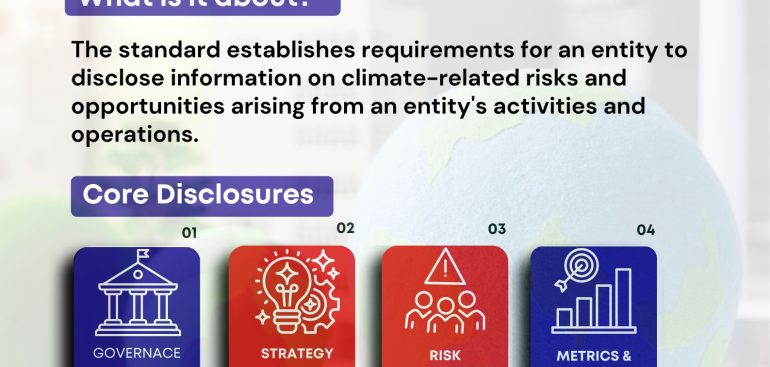
The International Public Sector Accounting Standards Board has issued a new standard on Climate-Related Disclosures – IPSASB SRS 1 – for application by all public sector entities, effective 1st July 2028.

The standard sets out requirements for entities to disclose information on climate–related risks and opportunities arising from their activities and operations. It provides disclosures on governance, strategy, risk management, and metrics and targets.

The new standard comes at a time when climate change poses serious financial, operational, and service-delivery risks to the country. To protect citizens and manage public resources, the government is required to respond quickly to climate change in a structured and accountable manner, disclosing climate-related issues in its books of account. 

“The IPSASB SRS 1 requires public sector entities to report on how climate affects their operations. This standard will be effective globally on 1st January 2028, while in Kenya it will be effective on 1st July 2028; however, early adoption is permitted,” PSASB CEO, FCPA Georgina Muchai said. 

By applying the standard, public sector entities will be required to disclose their exposure to climate risks, including extreme weather, rising costs, and infrastructure damage, as well as any opportunities, such as renewable energy and climate-resilient investment. The entities will also be required to report on climate policies, projects, and programs, and on whether these are delivering results.

The disclosures are designed to improve decision-making and accountability. When climate information is consistent, comparable, and verifiable, parliament, auditors, donors, and the public can see how effectively public funds are spent to manage climate risk and support sustainable development. This also strengthens government credibility when seeking funding from development partners.

“Due to the unique nature of the Public Sector, the IPSASB is currently working on another standard to provide guidance for reporting on Public Policy Programs and their outcomes,” FCPA Georgina said.

PSASB is currently reviewing the standard and will offer training, guidelines, and reporting templates to help public sector entities comply.

IPSASB Issues New Standard – Tangible Natural Resources Held for Conservation

IPSAS 51

The International Public Sector Accounting Standards Board (IPSASB) has issued a new standard, IPSAS 51, on tangible natural resources held for conservation, to ensure that public sector entities worldwide can recognise the value of the resources they protect, making ‘invisible’ natural wealth visible to the public.

This standard will be effective globally on 1st January 2028, while in Kenya it will be effective on 1st July 2028; however, early adoption is permitted. The standard aims to provide transparency into how tangible natural resources held for conservation change over time and to reveal whether those resources are being restored or depleted. A tangible natural resource held for conservation is a naturally occurring tangible asset that is managed to prevent its degradation.

“The new global standard was developed because vital environmental assets, such as forests, water bodies, and national parks, have historically been omitted from financial statements due to a lack of standardized reporting guidance,” PSASB CEO, FCPA Georgina Muchai said.

The new standard provides a standardized guide for public-sector entities to recognize and report tangible natural resources, specifically when they are held for conservation purposes. This ensures that environmental resources move from mere disclosure to recognition and measurement for inclusion in the financial statements.  By taking stock of natural resources, transparency is achieved through evidence-based data that reveal how their value changes over time. This ensures proper maintenance of the resources to avoid depletion and degradation and provides a clearer picture of the government’s true wealth.