PSASB Invites Comments on Annual Financial Reporting Templates

Advert

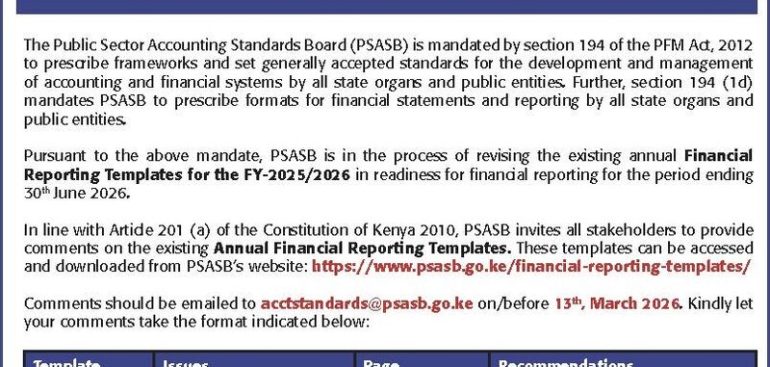
The Public Sector Accounting Standards Board (PSASB) is reviewing the existing annual financial reporting templates and invites all stakeholders to provide comments.

The annual financial reporting templates are designed to provide a standardized framework for financial reporting across all public sector entities. The templates aim to standardize reporting processes, improve the accuracy of financial information, and enhance compliance with the Public Finance Management Act (PFMA), 2012, and other relevant reporting requirements. Stakeholder engagement is a key part of the template development and review process.

PSASB stakeholders, including preparers of financial statements, auditors, professional bodies, civil society organizations, and members of the public with an interest in public sector financial management, are invited to review the templates and provide feedback. The input will be reviewed and incorporated into the existing templates to improve their effectiveness across all public sector entities.

“Public participation is part of our commitment to improving financial reporting across Kenya’s public sector, enhancing transparency and accountability in the preparation of annual financial statements. Our templates are user-friendly and aligned with international best practices,” PSASB CEO, FCPA Georgina Muchai said.

The templates can be accessed and downloaded from PSASB’s official website: https://www.psasb.go.ke/financial-reporting-templates. Detailed instructions for submitting comments are provided in the official advertisement published in on Tuesday 17th February 2026 on MyGov pullout: https://www.mygov.go.ke/sites/default/files/2026-02/MyGov%20February%2017%2C%202026.pdf

PSASB Launches Year-Two Course on e-Learning Platform

Cash to Accrual Accounting Year Two

The Public Sector Accounting Standards Board (PSASB) has launched Year 2 course on the e-learning platform to retool public sector accountants as their entities transition from cash to accrual accounting.

Year 2 of the transition requires entities to report inventory as a compulsory element in the financial statements, in addition to the financial assets and liabilities recognized in Year 1. Entities are encouraged to report on the noncurrent assets for which they have information.

The year 2 course is divided into two parts. Part 1 covers inventory – IPSAS 12, while Part 2 covers other non-current assets required to be reported in year 3 of the transition. These include Agriculture – IPSAS 27, Intangible Assets – IPSAS 31, Leases – IPSAS 43, and Property, Plant and Equipment – IPSAS 45.

“As we launch the course, we invite accountants from the transitioning entities to register on our e-learning platform to empower them with the skills needed to prepare better financial reports, which is a key factor in promoting accountability,” FCPA Georgina Muchai said.

Part one of the course focuses on the recognition, measurement, and disclosure of inventory. The content provides illustrative examples from the public sector and concludes with multiple-choice questions to assess learners’ knowledge.

‘‘The transition to accrual accounting is a key reform in public financial management. We want to support public sector accountants in building practical competencies that will improve the quality, reliability, and comparability of financial reports in line with international standards,’’ FCPA Georgina added.

The portal is now open, and public-sector accountants from the transitioning entities can register and take the courses at the following link: https://masomo.psasb.go.ke/.

For any inquiries, stakeholders can contact PSASB at acctstandards@psasb.go.ke.

New Rules Push Public Sector to Reveal Full Cost of Services

PSASB Chairman presents an award

Taxpayers are gaining more leverage to hold the government accountable for the use of public funds, a critical development that emerged from this year’s Financial Reporting Excellence (FiRe) Award held in Nairobi last week. This aligns with Article 201 of the Constitution, which establishes the fundamental principles of public finance, emphasizing openness, accountability, and the prudent use of public funds by all state organs.

The landmark shift from cash-based accounting to accrual-based accounting across public sector entities marks a significant milestone in the public sector’s financial reporting landscape. It provides a transparent slate through which citizens can scrutinise how their money is being spent. It further promotes accountability, the completeness of financial information, and comparability, which in turn improve the quality of decision-making in the public sector.

Cash-based accounting operates similarly to a restaurant’s cash register. It recognises revenue only when money is received physically and expenses when the money leaves the till. In contrast, accrual accounting provides a more realistic gauge of performance and profitability. It recognises revenue when it is earned and expenses when they are incurred, regardless of when the physical money changes hands. It also recognizes all assets and liabilities in the balance sheet, which greatly provides a clear picture of things.

“This year’s FiRe award marked the end of the evaluation of cash-based financial statements by the  National Government MDAs, County Governments, and their related entities. The awards also came at a time when a significant number of MDAs (66%) obtained an unmodified audit opinion for FY 2023/2024 financial statements, indicating the maturity for these entities to transition to accrual accounting. PSASB is looking forward to evaluating the first set of transitional financial statements for entities transitioning from cash to accrual accounting over a three-year transition period. PSASB and public sector entities have used the evaluation as a yardstick to improve the quality of financial reporting over the years,” PSASB CEO FCPA Georgina Muchai said, during the award ceremony at the Safaripark Hotel, last week.

This year’s public sector engagement in the FiRe Award has increased significantly, with participation by government entities rising by 37%. Overall participation in the evaluation process was 1,397 public sector entities, up from 1,020 in 2024. This year, we also considered new categories, such as public hospitals and municipal boards. Additionally, there was an overall public sector entity award, which recognized the best public sector entity across the various evaluation categories. This was scooped by the Ministry of Defence. PSASB congratulates all the entities that were feted in the just concluded award ceremony and urges them to continuously improve and champion other entities to follow in their footsteps.

The increased participation is a testament to the value that public sector entities have continued to accrue from the award over the years since their first participation in 2015. It also signifies the desire of public sector entities to enhance transparency and accountability, and to provide information relevant to the primary users of the financial statements for decision-making purposes.

“PSASB extends its sincere gratitude to the Capital Markets Authority (CMA), Institute of Certified Public Accountants of Kenya (ICPAK), the Nairobi Securities Exchange (NSE), and the Retirement Benefits Authority (RBA) for their sustained support as promoters of the Financial Reporting (FiRe) Award,” FCPA Muchai said.

To support non-commercial public sector entities in their transition to IPSAS accrual reporting, the PSASB develops guidelines on all newly issued IPSASB standards. These guidelines are essential for entity application, as they include local examples that ensure the standards are easy to understand and apply.

FCPA Georgina stated that PSASB has released four new accounting guidelines based on IPSAS standards, which apply to the Kenyan public sector entities as of July 1, 2025. These guidelines are based on IPSAS 43 on Leases, IPSAS 44 on Non-Current Assets Held for Sale, IPSAS 45 on Property, Plant, and Equipment, and IPSAS 46 on Measurement, and can be obtained from the PSASB’s website at www.psasb.go.ke. These standards are expected to improve financial reporting, strengthen accountability for public resources, and promote more prudent decision-making by government institutions.

“IPSAS 43 on Leases guides on the accounting for the right of use of assets like office buildings, fleets of vehicles, when they are leased, rather than purchased outright. IPSAS 44 governs how public entities display and disclose non-current assets that are no longer in use but are actively being marketed for an imminent sale. IPSAS 45 is the rulebook for reporting the value of the state’s most important, long-lasting physical assets: Property, Plant, and Equipment. The new standard replaces IPSAS 17 and provides additional guidance on infrastructure assets and heritage assets, which are prevalent in the public sector. Think of national hospitals, major roads, schools, government headquarters, and crucial machinery. IPSAS 46 is an overarching standard designed to ensure uniformity in the measurement of all other assets and liabilities across the public sector,” FCPA Georgina said.